
On the triumphal arch
At the far end of the nave, turn your attention to the arch framing the sanctuary. The fifth-century mosaics here depict the childhood of Jesus. The setting changes from the Old Testament events along the nave to the coming of Christ.
In the gold apse
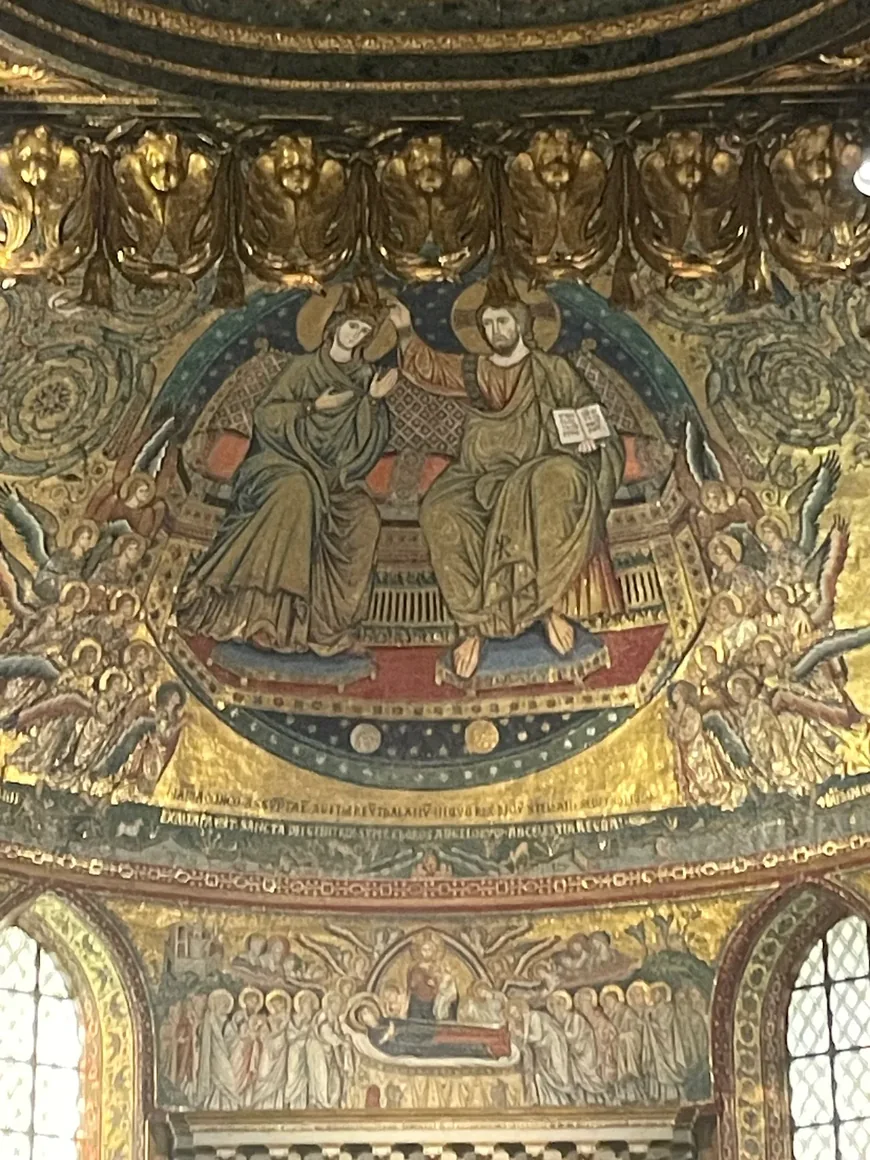
Beyond the arch, Christ crowns his Mother in a mosaic by Jacopo Torriti. Pope Nicholas IV commissioned the work in the late thirteenth century. Look lower down for scenes including the Annunciation and the Dormition of Mary.
At floor level
The patterned pavement is Cosmatesque work. In the right aisle lies the Bernini family grave, where Gian Lorenzo Bernini is buried with his father Pietro. Their workshops once stood directly behind the Pauline Chapel.
Common questions
Are all the mosaics from the fifth century?
The nave and triumphal arch belong to the fifth century. The gold apse showing the Coronation of Mary belongs to the late thirteenth century.
Who made the marble Nativity scene?
Arnolfo di Cambio carved the Nativity commissioned by Pope Nicholas IV for the Oratory of the Nativity in 1291.
Sources and further information
Visitor information checked by Crucis Tours on .